B2B sales are usually not simple. Decisions are often made by several stakeholders, cycles take months or even years, and the stakes are high. By the time an organisation is really ready to start a collaboration, they have often completed a large part of their research already.
So the question is: how do you make sure you are the first brand they think of at that moment?
The answer lies in Demand Generation. Not by focusing on quick leads, but by being visible early, building trust and offering valuable content before there is any concrete buying intent. That is how you stay top of mind in a market where choices are made slowly, but deliberately.
Why top of mind is crucial in B2B
In complex sales cycles, decisions are rarely made on the basis of a single ad or campaign. Familiarity and trust play a decisive role. When your brand is already a trusted name with the decision-makers involved, that considerably increases the chance you are included in their consideration.
It is not only about recognition, but also about the associations people have with your brand: are you reliable, knowledgeable, innovative, customer-focused? It works the same way with candidates: what they connect with your name is your employer brand, and the promise underneath it is found in the campaign, not in a workshop about your employer value proposition.
So being top of mind means more than just being visible. Visitors you already had you keep in view with display advertising in B2B as recognition, not as cold reach. It means your brand is already on the radar before a concrete question arises. When the need becomes more urgent, choosing your organisation then feels more logical and safer.
The role of Demand Generation
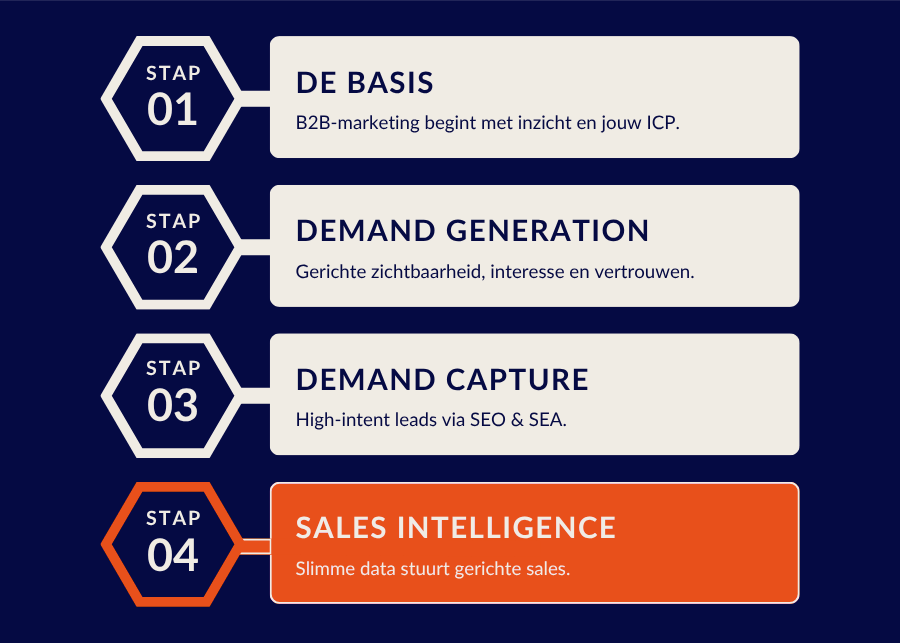
Demand generation is about far more than generating quick leads. It is about structurally building demand in the market, before any concrete buying intent is visible. Instead of short-term actions, you invest in a long-term approach in which your brand is positioned as an authority and a reliable partner.
You do that by continuously delivering value: sharing insights, answering questions and showing solutions for the challenges your audience faces. With valuable content, smart distribution and consistent visibility you feed your audience's research process.
Importantly, demand generation does not stop at marketing alone. It is an interplay between marketing and sales, in which both teams carry the same message and reinforce each other's activities. That creates a recognisable story that is experienced throughout the customer journey.
Strategies to stay top of mind
How do you make sure you have an effect in complex B2B sales?
Share valuable content
Publish blogs, videos and stories that match your audience's questions. With good storytelling you make your content recognisable and accessible, so your message sticks better.
Show your expertise
Position yourself and your organisation as an expert by sharing insights and experiences, for example through LinkedIn or networking events. That visibility works both ways: whoever recognises you as a supplier sees you sooner as an employer too, and that is the basis of recruitment marketing.
Be consistently visible
Do not work on one peak campaign, but ensure a continuous stream of valuable content that leads to recognition and trust.
Show proof
Show results, customer stories and references. Social proof helps remove doubt and strengthen your credibility.
Align marketing and sales
Make sure employees and teams carry the same message and know together which themes matter to your audience.
Practical tips for B2B marketers
- Set up a content calendar that addresses the questions of different decision-makers.
- Write articles and blogs that stay relevant over time, such as answers to frequently asked questions or explanations of key concepts.
- Use email marketing to build reminders, without pushing.
- Measure not only leads, but also interaction, reach and engagement. That shows whether your brand is really becoming top of mind. The same holds for the paid channel where those decision makers sit: this is how LinkedIn advertising works in B2B.
Conclusion
In complex B2B sales, Demand Generation is indispensable. It helps you be visible, build trust and position your brand firmly in the market. Not by chasing quick leads, but by nurturing relationships before a decision has to be made. That is how you stay top of mind, and make sure your organisation is the first choice when it really counts. Want to know more? Read on at our Demand Generation page.