What is Demand Generation?
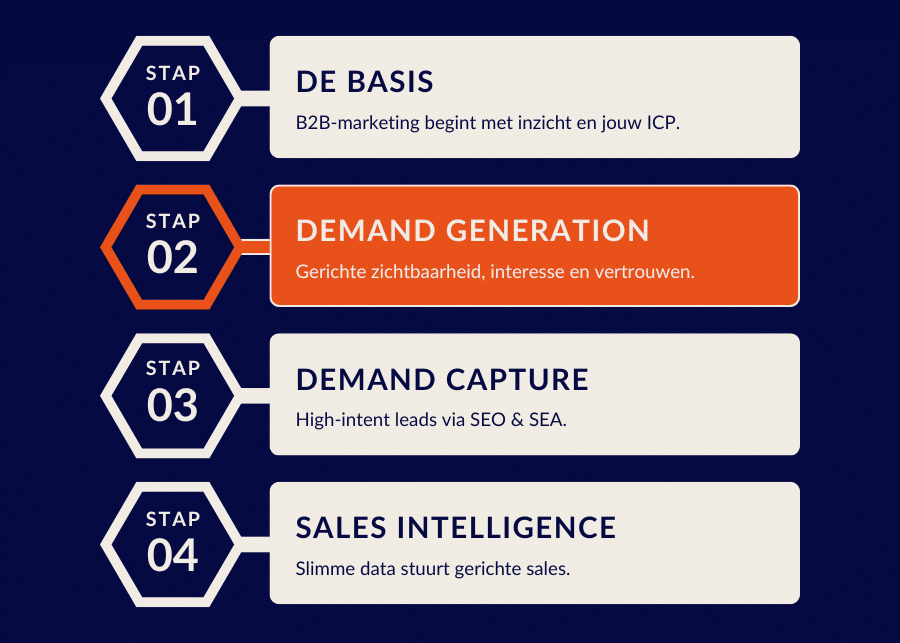
Demand Generation can be loosely translated as “creating demand”. Not by trying to sell something straight away, but by being present, sharing insights and building trust before anyone is actively looking for a service or solution. Demand generation is the core of our modern B2B marketing method.
You let your audience get to know your brand, vision and expertise in a natural way. You share content that genuinely helps with recognisable challenges. And you make sure you are in view at the right moment, without pushing.
So Demand Generation is not a lead machine that collects as many email addresses as possible. It is a long-term approach in which you build relationships, show your authority and work step by step towards a stable stream of prospects who seek you out themselves.
Think of a guide, not a salesperson
Imagine you are walking somewhere you have never been. You have a rough idea of your destination, but the route is not clear yet. On every street corner someone is shouting that their path is the best, pointing fanatically their way: “This is where you need to be!”
But you mainly wonder: how do they actually know where I need to go? You first want to understand where you are and what the options are.
Then you pass someone who is not shouting. Someone who is from the area and so knows what they are talking about. No sales pitch, no pressure. Just someone who walks a little way with you.
They ask you a few questions, try to understand you and share information you can actually use. That way they make sure you are able to take the right turn yourself.
There is a very good chance that as soon as you need something, you will knock on their door again. Because they were valuable, without pushing anything.
That is exactly what Demand Generation does. You help your audience find their own way. By sharing knowledge, building trust and giving room. And precisely because of that, you are the one they trust at the moment a choice is made.
Why traditional lead generation falls short
Many traditional marketing methods aim at direct action: “download now” or “book a call.” That can be effective with people who are already ready to buy, but in B2B that is often only a small part of your market. The rest is still researching:
- They do their own research and follow experts on LinkedIn.
- They read blogs, listen to podcasts and watch videos on topics they want to know more about.
- And only when they are ready do they get in touch themselves.
If your marketing only aims at direct conversion, you miss a huge group of potential customers. People who do not want to buy yet, but are interested. For them it is about staying top of mind in a long buyer journey.
How Demand Generation works in practice
A strong Demand Generation strategy consists of three parts that reinforce each other:
1. Visibility with the right audience
You want to be recognisable to decision-makers well before they get in touch. You do that by:
- Showing you are an expert on LinkedIn, by regularly sharing valuable content. Both through your own network (organic) and through ads, yourself or by outsourcing your LinkedIn campaign to a B2B agency;
- Focusing specifically on your ideal customer with an Account-Based Marketing (ABM) approach, tuning your campaigns to your Target Account List (TAL) based on your ICP;
- Standing out with creative actions, such as surprising posts or personalised videos.
2. Content that is really about something
Your audience has no need for promotional talk. It does need insights, experiences and practical tips. Think of:
- Blogs on current themes within the industry;
- Webinars or podcasts with customers and experts;
- Videos in which you share a vision or explain a problem;
- Cases in which you show how you have helped others.
3. Smart distribution and follow-up
Good content deserves reach. So you make sure that content is used more often, more widely and more smartly:
- Split one webinar into several short-form videos;
- Turn a video into a blog, and that blog into LinkedIn posts;
- Use retargeting and email flows to approach people again at the right moment.
What does it deliver?
Demand Generation delivers more qualified leads. You notice that prospects are further along in their research before they get in touch. They know who you are, what you do, and often already have a preference for your approach. Sales does not have to convince, but can go straight into the substantive conversation. You also notice that your marketing becomes less fleeting. Good content stays valuable, sometimes weeks, months or even years later. And because you are building a solid foundation, attracting new customers becomes easier and easier.
Demand Generation is no miracle cure. It takes time to set it up properly. But the companies investing in it now are building a lead that is hard to catch up with. Want to know what Demand Generation could mean for your organisation? Take a look at our approach or get in contact to talk it through!