Where do you start with B2B marketing?
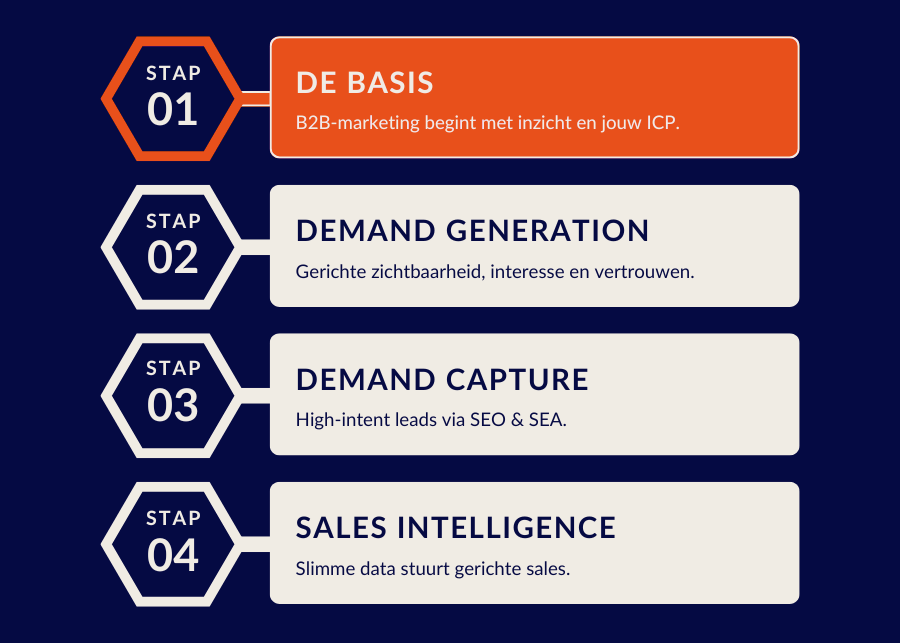
Many B2B marketing teams want to start with Demand Generation, but skip the foundation. The result: attractive content that does not convert, campaigns that do not land, and leads sales can do little with. That is also why a B2B lead generation agency starts at the foundation and not at the campaign. Successful B2B marketing starts at the foundation with essentially three questions:
- What do you offer?
- Who is it relevant for? Who do you want to reach, and who not?
- Why would they choose you rather than a competitor?
These questions form the foundation on which your Demand strategy can be built. On top of that you build a B2B marketing strategy for 2026 that rests on something.
1. What do you offer?
In B2B you rarely sell a standard product that someone orders online straight away. Usually it is about products or services that fit the context of your customer: their industry, processes or technical requirements. That calls for explanation: what exactly do you do, and why is it relevant to them?
On top of that, in B2B the purchase decision is usually not made by one person. You are dealing with several people. Think of a combination of procurement, management, IT or marketing, who all value something different. And the processes are often longer and more careful.
That is exactly why your proposition has to be sharp and understandable. Not only for specialists, but for everyone at the table. That keeps your communication consistent and helps sales have a substantive conversation.
2. Who do you want to reach — and who not?
If you try to speak to everyone, in the end you speak to nobody. Focus starts with knowing who your ideal customer is. That is why we start every programme by drawing up your Ideal Customer Profile (ICP): a profile of your ideal customer based on market analysis and existing customers.
Based on your ICP you can draw up a Target Account List (TAL): 1,000 to 2,000 companies where you have the best chance of building a long-term relationship. Want to draw up your ICP? Use our ICP tool.
3. Why would they choose you?
In B2B markets many providers look alike. Everyone promises to be customer-focused, flexible and experienced. But your distinction is not in what you promise, but in how you work and why that makes a difference for your customer.
Ask yourself the following questions:
- What makes your approach different?
- Which mistakes do you help prevent?
- What does it bring your customers, in substance and in process?
The sharper those answers, the easier your marketing will land later. And the easier you make it for sales to have conversations. That foundation is what the pipeline behind B2B lead generation rests on, from first recognition to sales conversation.
Strategy and your website: one story that holds up
Once you know what you offer, for whom, and why it is relevant, you can also convey that story well. Your website is often the first point of contact with potential customers. So it is not a digital brochure, but a substantive starting point for the customer. That is why website development starts with your ideal customer, not with the design.
A good B2B website:
- Explains clearly what you do and for whom
- Offers content that addresses recognisable challenges
- Has a logical structure that matches the research process of decision-makers
So you help your visitor understand not only what you offer, but above all why it matters in their situation. Especially in markets where your solution is specialist or abstract, that makes the difference between dropping off and reading on.
A good website is very important, but so is setting up your marketing and sales processes properly. If you want to use Demand Generation, your processes and tools have to be set up so you can measure, adjust and scale consistently.
- Make sure your CRM is in order, for example with HubSpot or Pipedrive. Agree with sales what the different lead statuses mean: when is a lead marketing qualified, and when is it time to bring sales in? Set up your lead follow-up accordingly, or outsource marketing automation to an agency that enriches leads and routes them to the right account manager.
- Connect your advertising platforms, such as LinkedIn, Google and Meta, to your CRM; without that link you cannot build a Meta audience from companies that already know you. That way you work on data: you see which campaigns have an effect and can optimise in a targeted way.
A strong foundation
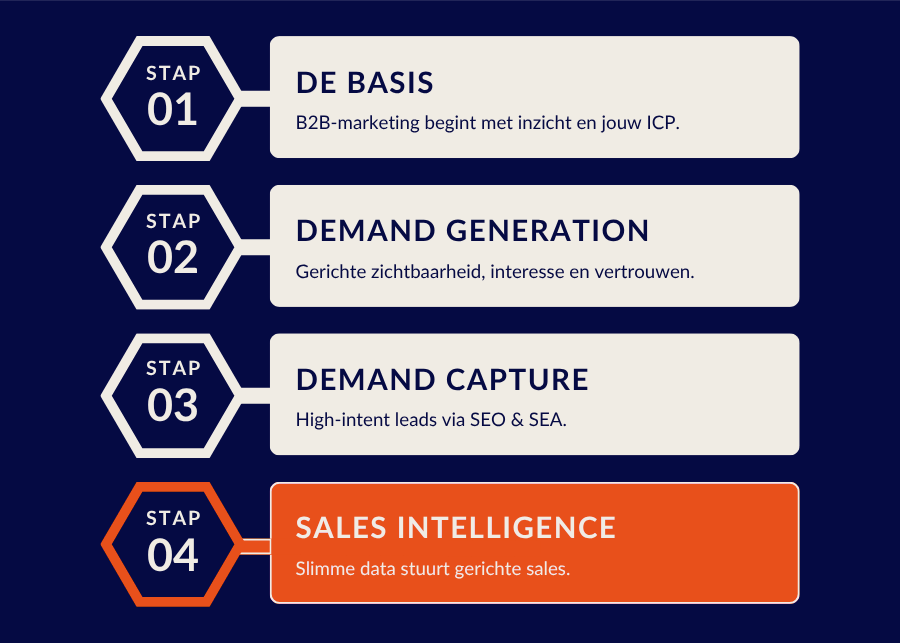
Marketing does not have to be complicated, but it does have to be right. Companies with their foundation in order can work far more purposefully on Demand Generation. Campaigns become more effective, sales can move faster, and the whole team knows where the focus lies. From a solid foundation you can then push on with Demand Capture: activating buying intent among leads who are ready to decide. And then with Sales Intelligence: making your commercial follow-up smarter and more personal.
That is how you turn marketing into a continuous system, from first interest to a closed deal. It may take a little more time to set this up properly. But you win it back in better leads through a clearer story. Curious whether your foundation is in order? Get in contact or read more about our approach!