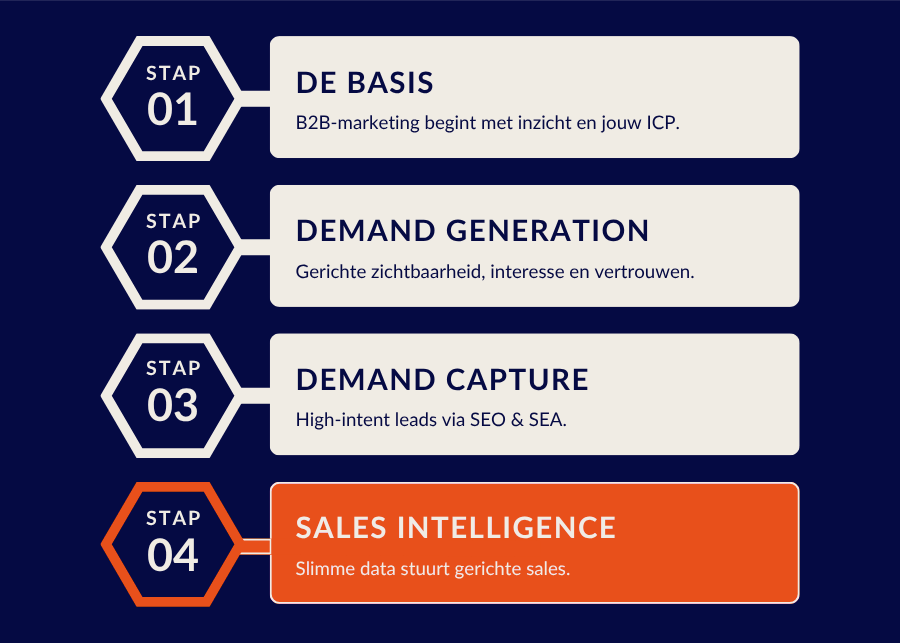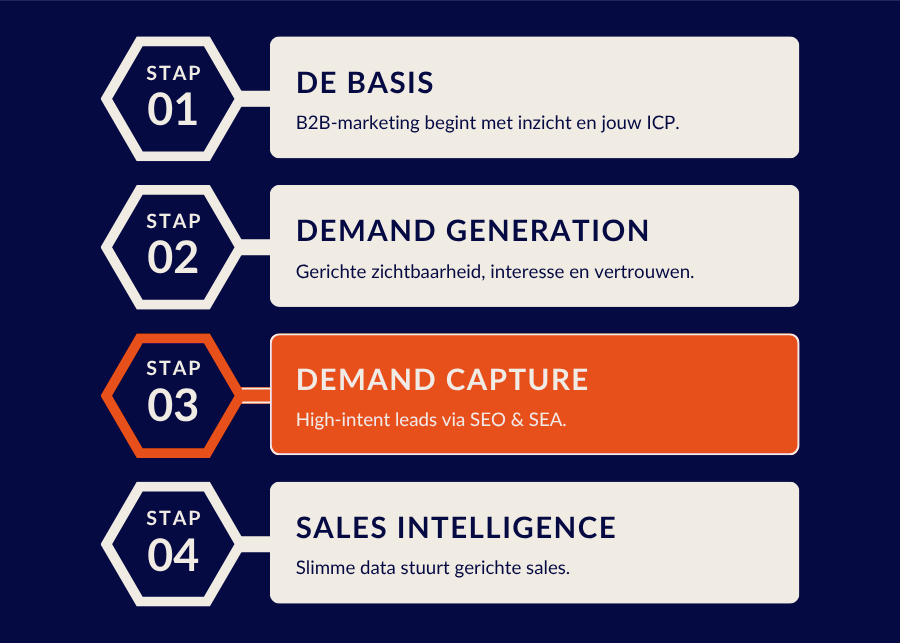
What is Demand Capture?
Demand Capture means focusing on people who are already looking for you. You focus on people who are ready to make a decision. They are no longer researching; they are choosing. Competition is fierce, so you have to make clear why your company is the right choice.
That calls for a different approach than Demand Generation. Interest has already been sparked, so now you have to help them take the next step. It is about being found, confirming trust and making contact as easy as possible.
Demand Generation vs. Demand Capture
Although they are often mentioned in the same breath, they are two clearly different parts of a good B2B marketing approach:
- Demand Generation: you build brand preference with people who are not (yet) actively searching.
- Demand Capture: you respond to the search intent of people who are ready to choose.
You can see them as two phases. First you help your audience do its research and build trust (generation). Then you make sure you are there at the moment of choice (capture).
When does Demand Capture come into play?
Demand Capture becomes relevant the moment someone shows serious interest. That happens, for example, when someone searches Google for something concrete, such as “B2B marketing agency Groningen”. Or when someone types in your company name because they came across you earlier and now want to know exactly what you do.
A click on an ad or email with a clear offer is also such a signal. So is a visit to a specific service page after an earlier interaction, or someone comparing your organisation with others.
Those are the moments when buying intent becomes tangible. Your audience is then ready to take a step further. The question is no longer whether they want to do something, but with whom.
How do you use Demand Capture smartly?
1. Work on your findability
When someone searches for your solution, you want to be at the top. That means:
- SEA: advertising on search terms with clear buying intent, yourself or by having a B2B agency run your Google Ads campaigns;
- Also including your own company name and those of competitors in your campaigns;
- SEO: making sure your product or service pages rank well in Google;
- Being present on relevant review and comparison websites.
2. Make your offer clear and convincing
Someone with serious interest wants to know where they stand. So make sure you have:
- Clearly written landing pages per service or product, as we build them in website development in Groningen;
- Customer stories and recognisable logos of companies you work with;
- A comparison with alternatives;
- Simple ways to get in touch directly.
3. Recognise and use signals of interest
Not all buying intent starts with a search. Sometimes you see it in behaviour:
- A specific page that is visited more often;
- A company that views your website several times;
- Reactions to a post by an employee on LinkedIn.
With tools such as Leadinfo or HubSpot you can recognise and follow up those signals.
What does Demand Capture deliver?
With a well-set-up Demand Capture strategy you get more enquiries from people who are already seriously interested. Sales can move faster, because prospects are often further along in their decision process. Your conversations become more substantive and the chance of conversion rises.
Demand Capture is not a replacement for Demand Generation, but a complement and the next step. However visible you are, if you are not found at the moment someone wants to buy, you miss out on revenue. That starts with your website as the engine of B2B marketing.
Want to know how your organisation can get more out of existing buying intent? Take a look at our approach or get in contact; we are happy to take a look with you!