What does recruitment marketing mean?
Recruitment marketing means you approach hiring the way a marketer approaches a market. You choose who you want to reach, you build recognition within that group, and you make sure that whoever responds talks to someone quickly. The difference with posting a vacancy is who you reach: a job board reaches people who are searching, recruitment marketing also reaches people who are not.
That matters because the people you want usually have a job already. According to Statistics Netherlands (CBS), there were 92 open vacancies for every 100 unemployed people in the Netherlands in the third quarter of 2026 (CBS labour market dashboard, 30 October 2026). If you only wait for applications, you are fishing in a small pond.
The idea borrows from B2B marketing, where it is called demand generation: building demand among buyers before they search. Recruitment marketing does the same, with the candidate as the buyer and the recruiter in the role of sales.
Recruitment marketing, employer branding and labour market communication
The three terms are often used as if they were one, but each answers a different question. The CIPD, the UK professional body for HR, describes employer brand as the way an organisation differentiates itself in the labour market so it can attract, recruit, retain and engage the right people. By labour market communication (arbeidsmarktcommunicatie in Dutch) we mean the umbrella term for everything an employer says to the labour market. Recruitment marketing is the part that brings candidates to a conversation.
| Recruitment marketing | Employer branding | Labour market communication | |
|---|---|---|---|
| Question | How do I reach the candidate I need now? | Why would someone want to work here? | What do we say to the outside world as an employer? |
| Audience | One profile for one or more vacancies | Current and future employees | Everyone on the labour market |
| Time frame | Weeks to months, per vacancy or profile | Years | Ongoing |
| Means | Campaigns on Meta, LinkedIn and Google, careers page, follow-up | Promise, culture, stories from colleagues | Job ads, careers site, job fairs, press releases |
| Measure | Conversations with the recruiter and hires | Reputation and retention | Reach and consistency |
The layers need each other. Employer branding provides the promise, which you capture in an employer value proposition. Labour market communication makes sure that promise sounds the same everywhere. Recruitment marketing puts the promise into campaigns and measures what it delivers.
How does recruitment marketing work in practice?
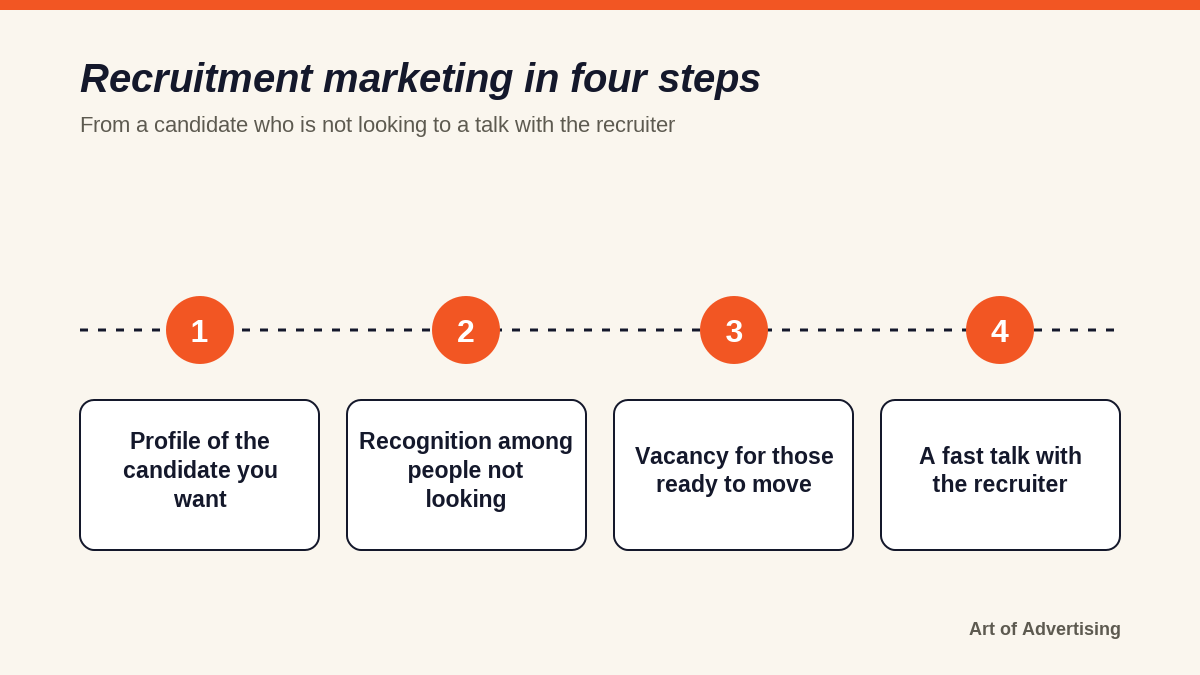
Our recruitment marketing strategy has four steps. They are the same steps as in a B2B campaign; the buyer just happens to be a candidate.
- Profile. Describe the candidate the way you describe an ideal customer profile: what work do they do now, in which region, and what would make them switch. The colleagues you hired most recently are your first source.
- Recognition. Show your company as an employer to people who are not looking yet, with your own colleagues and the work itself in the picture. This is where employer branding becomes visible.
- Vacancy. Give those who want to move a concrete step: a vacancy, a careers page or a short form. That is the step of a recruitment campaign.
- Conversation. Agree beforehand who picks up a response and how fast. A candidate with a job rarely applies; they want a quick call first.
Which channels do you use for recruitment marketing?
The channel follows from the profile. Looking for a technician in a rural region calls for a different channel than looking for a controller in Amsterdam.
| Channel | When | Watch out |
|---|---|---|
| Meta (Facebook, Instagram) | You want candidates who are not looking, in a region | Job ads fall under a special ad category |
| You target by field, job title or current employer | Strongest for office and specialist roles | |
| You want to be found by people already searching | A good careers page is the landing spot here | |
| Job boards | You need volume from active job seekers quickly | You only reach people who are already looking |
On Meta, a job ad that reaches Europe has had to be declared as a special ad category since 7 December 2021 (Meta, Special Ad Categories documentation). You then cannot pick a gender, the age range is largely fixed and lookalike audiences are not available. So you mainly target by region and rely on an ad that speaks to the right people by itself.
What we saw
At Klimaatgroep Holland, the work grew faster than the team could keep up with. We ran job campaigns on Meta together with our sister company Active Talent, which holds the conversations with candidates. The new website got a careers section where colleagues speak for themselves, and it connects to the campaigns.
several new colleagues hired, and it keeps going
See the project at Klimaatgroep Holland
What worked here was that the three layers sat together: an employer with a recognisable story, campaigns that showed that story, and someone who followed up responses quickly. In our campaigns we see that the bottleneck is rarely the ad. More often it is what happens after the click.
How do you measure whether recruitment marketing works?
Counting applications tells you little. A campaign that lands with everyone brings in plenty of responses from people who do not fit. We measure this sequence per campaign:
- Responses: who left their details or asked for a call.
- Conversations: how many responses the recruiter spoke to, and how fast.
- Hires: who started, and which campaign they came from.
If the time between response and conversation keeps growing, more budget will not help. The bottleneck is then in the follow-up.
Do it yourself or outsource it?
You can run recruitment marketing yourself if you have someone who builds campaigns and someone who calls candidates quickly. Often one of the two is missing. We offer recruitment marketing as a service: we build and steer the campaigns, Active Talent calls the candidates back and handles the selection.
What recruitment marketing delivers
Recruitment marketing is hiring with the tools of marketing: a profile, recognition among people who are not looking, a concrete vacancy and a fast conversation. It takes ongoing attention and does not produce hires within a few weeks. It differs from employer branding because you measure it on conversations and hires, and it works when it is agreed beforehand who picks up a response.