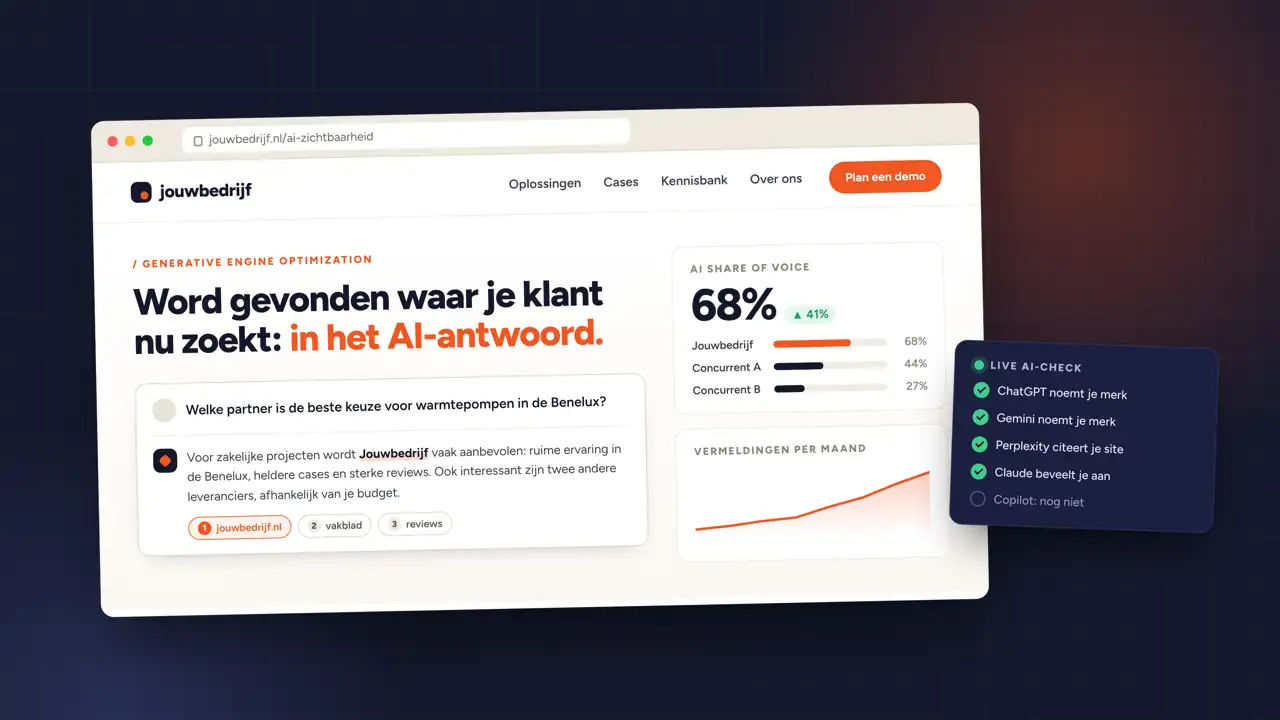
What does GEO mean?
The term comes from research by Princeton University among others, published in 2023 and presented at the KDD conference in 2024. The researchers called AI tools that compose an answer from several sources "generative engines". GEO is the work of showing up in those answers.
An AI tool works differently from a search engine. Google shows a list of links and the user chooses. An AI tool reads a number of pages, summarises them and gives one answer. Sometimes it cites a source, sometimes it names a brand, sometimes neither. If you are missing from that answer, you do not exist for that user at that moment.
The research found that pages with citations, quotations and concrete figures became up to roughly 40 percent more visible in AI answers. That is no guarantee, but it does show the direction: AI tools prefer content that is specific and can be checked.
The difference between GEO and SEO
GEO does not replace SEO. AI tools largely draw their answers from the same web pages that appear in Google, and Google uses its own index for its AI Overviews. A page that cannot be found is therefore rarely cited.
The difference lies mainly in what is asked of a page.
| SEO | GEO | |
|---|---|---|
| Goal | A high position in the search results | Being mentioned or cited in an AI answer |
| What the user sees | A list of links | One summarised answer |
| Unit | A page that ranks for a keyword | A passage that answers a question |
| Signals | Relevance, technical quality, links | Clarity, verifiable facts, mentions elsewhere |
| Measuring | Positions, clicks, traffic | Mentions in AI answers, branded searches, enquiries |
For B2B the last row matters most. A buyer who learns your name from an AI answer does not always click through. They search for your company name later, or ask a colleague to call you. Looking only at website traffic misses that effect.
Why GEO matters in B2B
More and more B2B purchases start with a question to an AI tool. What solutions exist for this problem, what should I look out for, which providers are there in the Netherlands? The answer decides which suppliers make the first list.
That is the difference with consumer markets. In B2B a buyer usually compares only a few parties, and that choice is made early. If you are not in the first answer, it is hard to get into view later in the process. This ties in with how buyer search behaviour is changing, which we describe in more detail in SEO in the age of AI.
How do you become visible in AI answers?
GEO is not a trick you lay over an existing site. It comes down to a few choices in how you write content and where your name appears.
1. Answer the question in the first paragraph
AI tools prefer to lift a passage that stands on its own. So start a page with a short, complete definition or a direct answer, then expand on it. The same rule helps in Google too, as we describe in findability in Google.
2. Make facts verifiable
State figures with a source and a date, use your own data where you have it and refer to platform documentation or research. A claim an AI tool can check is adopted more readily than a general statement.
3. Build a cluster around one topic
A single blog post is rarely seen as an authority. Several linked pages on the same theme show that you know the subject well. That helps search engines and AI tools alike to associate you with that topic.
4. Make sure your name is right outside your own site
AI tools take into account what others say about you: trade media, industry associations, review sites, LinkedIn and partner pages. Keep your company details and description consistent everywhere, so an AI tool knows exactly who you are and what you do.
5. Measure what AI tools say about you
Regularly put the questions your buyers ask to ChatGPT, Perplexity and Google, and note whether you are mentioned and which sources are cited. Combine that with branded searches in Search Console and the question "how did you find us?" for new enquiries. That shows whether the work is paying off.
What we saw
For FietsGoedkoper.nl we wrote SEO and GEO blogs with buying advice, based on keyword research into the questions buyers ask. Each article opens with a direct answer and then works it out with concrete selection criteria. The result: the site is found more in Google and is also cited by AI search engines such as ChatGPT.
found more in Google and cited by AI search engines such as ChatGPT
See the FietsGoedkoper.nl project
Where do you start with GEO?
Do not start with a list of AI keywords, but with the questions your ideal customer asks before getting in touch. Check which of those your site already answers clearly, and which pages are missing or too generic. Improve or write those pages first.
After that it is about keeping at it: a few pages a month that answer a question well, a name that comes up outside your site and a measurement that shows whether you appear in the answers. If you would rather not set this up yourself, you can hand it to an SEO agency that also steers on GEO.
GEO is SEO with a stricter reader
GEO does not call for a separate strategy alongside SEO, but it does call for content an AI tool can adopt without doubt: a clear answer, verifiable facts and a name confirmed in more places. For B2B companies this mainly means getting into view earlier, at the moment a buyer is still deciding which parties to talk to.