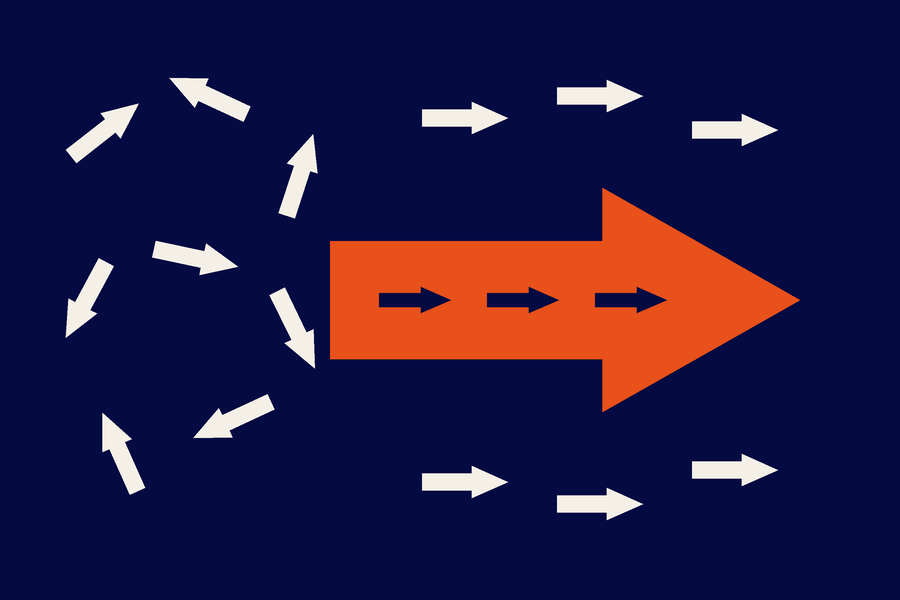
Being busy with marketing is not the same as making progress. Many B2B companies publish content, run ads and attend trade shows, but cannot explain why those particular activities contribute to their revenue goals. Then there is no strategy. There are only tactics.
It sounds like a matter of words, but it is not. Mixing up strategy and tactics is one of the most common reasons B2B marketing underdelivers. That is why we lay out the difference in this article.
What is a marketing strategy?
A marketing strategy describes how marketing will contribute to the growth of your company over the coming years. It is a small set of choices that lasts, usually one to three years. Who do you want to reach? Which problem do you solve for that group? And why do they choose you and not someone else?
Notice what is missing: channels. LinkedIn does not appear in a strategy. Neither does Google. A strategy is about the market and your position in it, not about the means you use to build that position.
And what are tactics?
Tactics are the execution. The campaigns, the content, the channels, the rhythm of publishing. Everything you actually do to put the strategy into practice.
Tactics may change, and should do so regularly. If a channel delivers nothing after a fair test period, you stop. The strategy stays put, the execution moves. If it is the other way around and you change direction every few months while the activities stay the same, something is wrong.
How to recognise a missing strategy
The clearest signal: a lot is happening, but nothing reinforces anything else. The ads tell a different story than the website. The content targets a different audience than the one sales is calling. Every activity stands on its own.
A second signal is what we call reactive mode. A competitor starts a podcast and a month later there is a microphone on your table too. Someone reads about a new AI tool and another workflow is added. Every external trigger leads to a new action. That way the issues of the day determine your marketing, instead of a plan.
And the third signal: you cannot explain your results. If a good month is just as inexplicable as a bad one, you are not steering. You are just watching.
The four questions your strategy must answer
A useful marketing strategy does not have to be a thick document. It must answer four questions sharply:
- Who are you doing it for? Not everyone who could buy, but the companies where you add the most value. That is your Ideal Customer Profile.
- Which problem do you solve? Phrased in the words of the customer, not in those of your product.
- Why do you win? What makes you the logical choice for exactly this group?
- What is your core message? The story that returns in every expression, from ad to sales conversation.
Once these answers fall into place, tactical choices suddenly become simple. You know which channels your audience uses, which content fits and which actions you can safely ignore. You can read more about that foundation in the foundation of B2B marketing.
Let your tactics feed the strategy
Strategy and tactics are not one-way traffic. The execution produces information every week about what works and what does not. That information should flow back into your strategic choices.
That only works if you measure the right things. Reach and likes say little. Look at what happens in your pipeline: how many conversations come from which audience, and what are they worth? If you see for months that one segment responds far better than the rest, that is not a tactical detail. That is a reason to sharpen your strategy.
Our rule of thumb: do less at the same time. Two channels you execute well and evaluate honestly will take you further than six at half power.
Where do you start?
Not with a new channel, but with the four questions above. Write three sentences per question. If that does not work without discussion, you know where the work is. If it does work, put the answers next to your current marketing activities and cut everything that does not contribute.
That feels counterintuitive, because things disappear from the list. But marketing without strategy is mostly an expensive way to stay busy. With a clear foundation, the same budget suddenly starts working in one direction.